

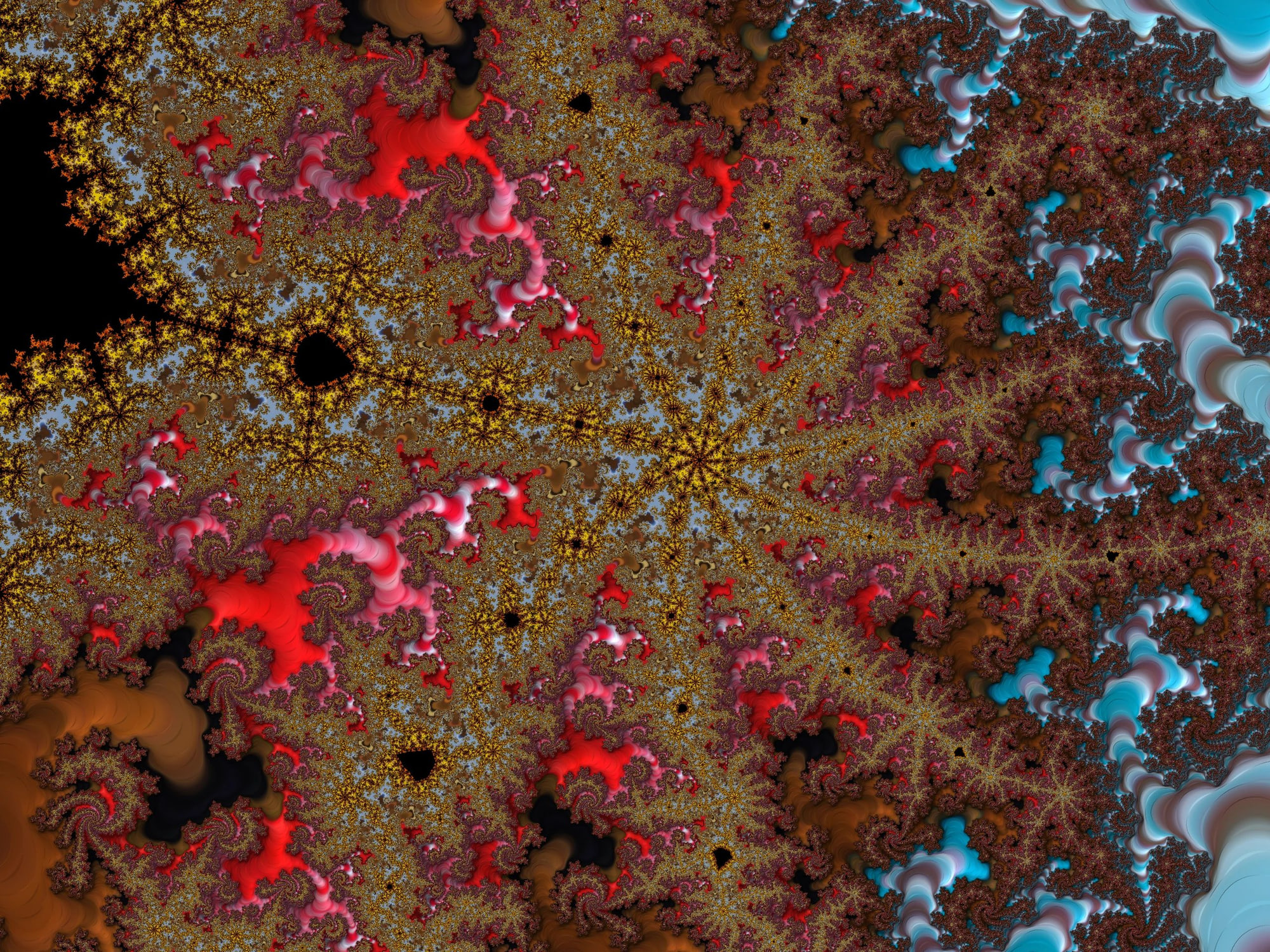
Somewhere between mathematics and imagination lies a place where geometry seems to dream.
A place where spirals unfurl like galaxies being born, where glassy valleys glow with molten color, where patterns echo themselves endlessly—yet never quite the same way twice.
Welcome to the strange, cinematic worlds inside the Mandelbrot set.
Most people look at a fractal and see shapes.
Artists, explorers, and the curious see stories.
And when you zoom into a fractal with enough precision, those stories unfold like chapters in a book that writes itself as you turn the pages.
The Fractal as a Storyteller
At first glance, the Mandelbrot set is just a black silhouette on a plane.
But the moment you cross the boundary and begin to zoom, the scenery changes fast: spirals emerge, valleys open, textures shift from velvet to crystal. There’s an uncanny sense of purpose—like you’re walking through a landscape designed by nature’s most patient architect.
Each region has its own personality:
- Soft cloud-like gradients that feel atmospheric
- Delicate filigrees that look hand-drawn
- Jagged cliffs and lightning forks that feel almost storm-born
- Organic shapes reminiscent of coral, ink, or nebulae
It’s math, yes.
But it feels like myth.
Worlds Within Worlds
Every deep zoom is a journey into a story that wasn’t there a moment ago—yet was always waiting to be discovered.
A few examples from the Gallery:
Glassy Vortices
Here, spirals twist like frozen storms—a swirling ballet paused mid-motion. The colors shine like blown glass under a spotlight.
Lava Reefs
Flowing tendrils drift outward in waves, forming something that looks equal parts coral reef and cathedral architecture.
Fractal Starforge
A frozen starburst of fractal geometry — icy blues, molten reds, and golden lattices unfolding into a world that feels half-cosmic, half-imagined. One of the many dreamlike scenes hidden inside the Mandelbrot set.
And these worlds only reveal themselves through motion.
A single zoom gesture can take you from cosmic scale to microscopic detail in seconds—each one more intricate and surprising than the last.
Math Gives the Structure. You Give the Meaning.
One of the most creative aspects of fractal art is how much interpretation happens in the mind of the viewer.
Two people can look at the same region and see entirely different things:
- One sees storms
- Another sees feathers
- Another sees ocean currents
- Someone else sees alien architecture
The fractal isn’t telling a single story—it’s offering infinite possibilities.
The Artist’s Toolkit: Light, Color, and Depth
With tools like Mandelbrot Metal, the raw math becomes a canvas.
Color becomes mood.
Lighting becomes atmosphere.
3D Look becomes depth and drama.
A palette might give a region the look of molten magma, or frost, or cosmic dust.
A small shift in color gradient or contrast can turn a placid scene into something electric and alive.
Each choice transforms the “dream” of the fractal into something uniquely yours.
And many artists return to the same coordinates again and again—because in a fractal, even familiar places reveal new secrets at every scale.
Why Fractals Inspire the Creative Mind
Fractals sit at the intersection of two worlds:
Logic and imagination.
Precision and emotion.
Equations and art.
You begin with pure mathematics.
But the experience is anything but mathematical.
It’s cinematic.
Organic.
Unscripted.
And deeply personal.
Exploring fractals is like exploring your own imagination—except the landscape pushes back, offering ideas you didn’t expect.
What World Will You Discover Next?
The Mandelbrot set isn’t just a formula.
It’s a universe of stories waiting to be uncovered.
So the next time you zoom into a fractal—whether you’re creating art, seeking inspiration, or just wandering—look closely.
You might find a world no one has ever seen before.
And the best part?
It’s already in there, waiting.