

A Friendly Guide for the Non-Math Crowd
Mandelbrot Metal relies on some surprisingly deep math under the hood — but the core idea behind the Mandelbrot set is much simpler than it looks. If you’ve browsed the tech sections of my website, or explored the Creative Guide or FAQ, you’ve probably seen the phrase complex numbers come up again and again.
If that term sounds intimidating, don’t worry. Here’s a clear, intuitive explanation of what complex numbers actually are — no math degree required.
A Number With Two Parts
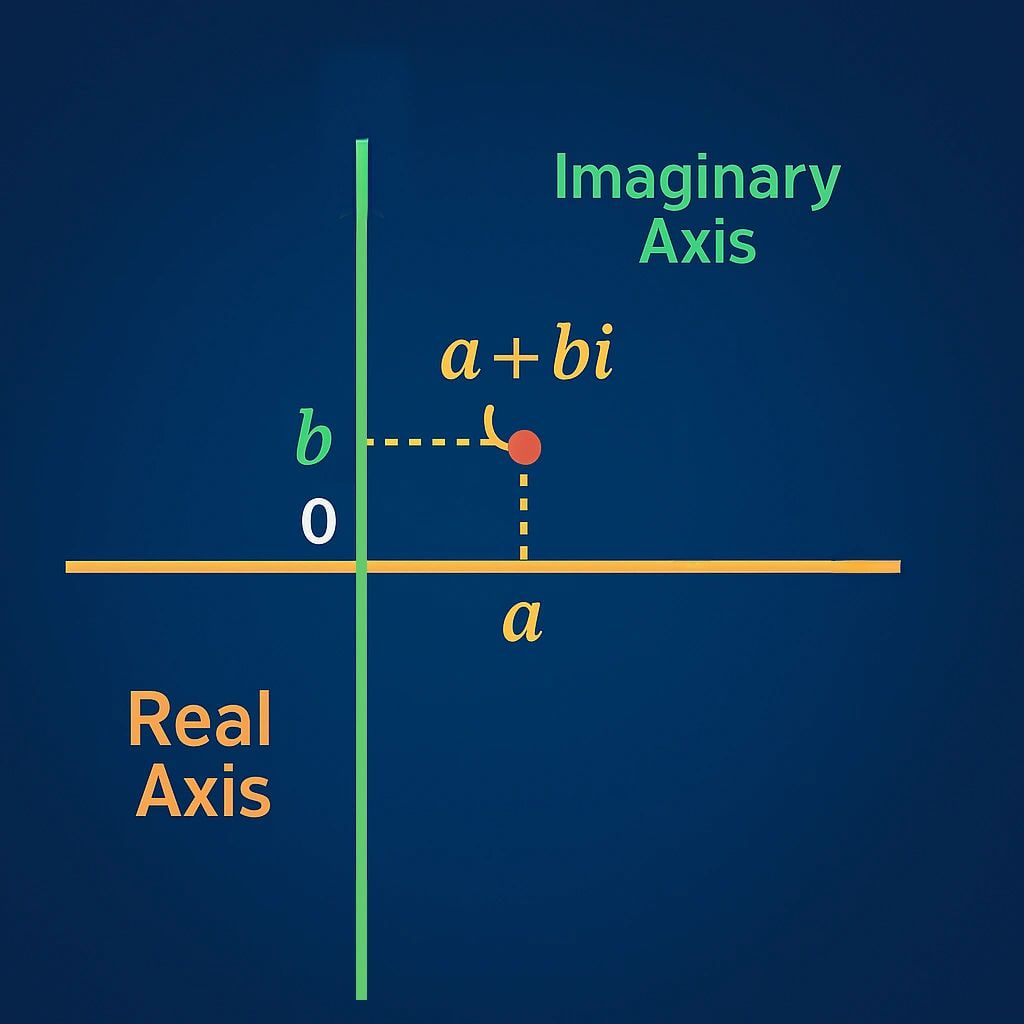
A complex number is just a number with two components:
- a real part — the everyday number line we all know
- an imaginary part — a second direction, perpendicular to the first
That’s it. Two values that describe one point.
The Map Analogy
Imagine a map.
If someone tells you, “Walk 3 miles east and 4 miles north,” they haven’t given you two separate destinations. They’ve given you one location described by two directions.
Complex numbers work exactly the same way:
- the real part acts like east–west
- the imaginary part acts like north–south
Together, they form a single point on a 2D plane.
And despite the name, “imaginary” doesn’t mean fake — it’s just the historical term mathematicians chose for that second axis.
Why They’re Useful
Once you allow this extra direction, all kinds of problems that are impossible (or extremely messy) on the normal number line suddenly become simple and elegant.
- Adding complex numbers? Just like moving around on the map.
- Multiplying them? Now you’re rotating and stretching the point — and that’s where things start to get visually interesting.
This little two-part number turns out to be one of the most powerful tools in science and technology.
Where You’ve Seen Them (Even If You Didn’t Realize It)
Complex numbers play a huge role in:
- signal processing
- electrical engineering
- computer graphics
- quantum physics
- fluid dynamics
- 3D rendering
- and of course… fractals
In fact, the Mandelbrot set — the heart of Mandelbrot Metal — is generated by repeatedly multiplying and adding complex numbers. That simple rule produces the infinite structure you explore in the app every day.
Want to Go Deeper?
If this sparked your curiosity, I’ve got a friendly explanation of fractals on this website.
Understanding the basics isn’t just interesting — it makes the art you create feel even more meaningful.