
Intro — A Simple Question That Breaks Geometry
How long is the coastline of Britain?
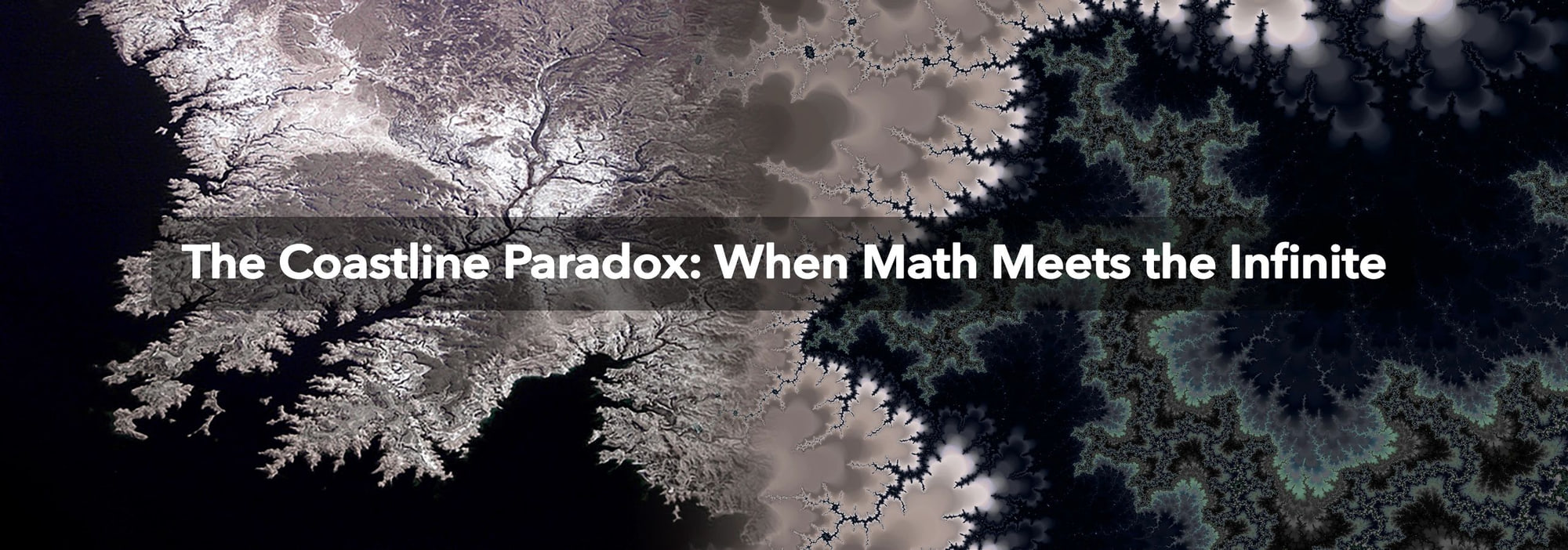
That sounds like something we could look up, right? But as mathematician Benoit Mandelbrot showed, the answer depends on how closely you measure. Use a ruler 100 miles long, and you get one number. Use a 1-mile ruler, and the number gets longer. Use a 1-foot ruler, and it grows longer still. Zoom in to every jagged inlet and rocky edge — and the coastline’s length approaches infinity.
That’s the coastline paradox — nature’s quiet rebellion against smooth geometry.
Fractals: Nature’s Hidden Blueprint
Mandelbrot realized that coastlines, clouds, mountains, and even tree branches all share a secret structure: self-similarity.
Zoom in, and you find echoes of the whole — shapes that look familiar at every scale. These forms can’t be described by the neat dimensions of Euclid (1D lines, 2D surfaces, 3D volumes). Instead, they live in between — fractional dimensions.
A coastline isn’t 1-dimensional or 2-dimensional; it’s something like 1.25. That number is the fractal dimension — a measure of how complexity grows as you zoom in.
From Britain’s Shores to the Mandelbrot Set
The same principle that makes a coastline impossible to measure is what gives the Mandelbrot set its infinite depth.
In Mandelbrot Metal, when you zoom deeper into a spiral or filament, you’re seeing the same kind of “infinite roughness” — patterns that repeat endlessly, but never exactly the same. Each level reveals new intricacy, just as every new measuring stick reveals more of a coastline’s detail.
That’s why fractals feel alive: they resist simplification.
Infinity on a Screen
Thanks to modern GPUs, what once took hours of computation now unfolds instantly. Mandelbrot Metal renders those infinite coastlines of the complex plane in real time — a living illustration of the paradox Mandelbrot described half a century ago.
Each zoom level in the app is a new ruler on an impossible coastline — sharper, finer, endlessly unfolding.
Conclusion — The Beauty of the Unmeasurable
Fractals remind us that the universe isn’t made of smooth edges and perfect circles — it’s made of complexity, irregularity, and endless surprise.
The next time you trace a coastline, or zoom into a fractal, think of it as the same story told two ways: the geometry of nature, and the art of infinity.