

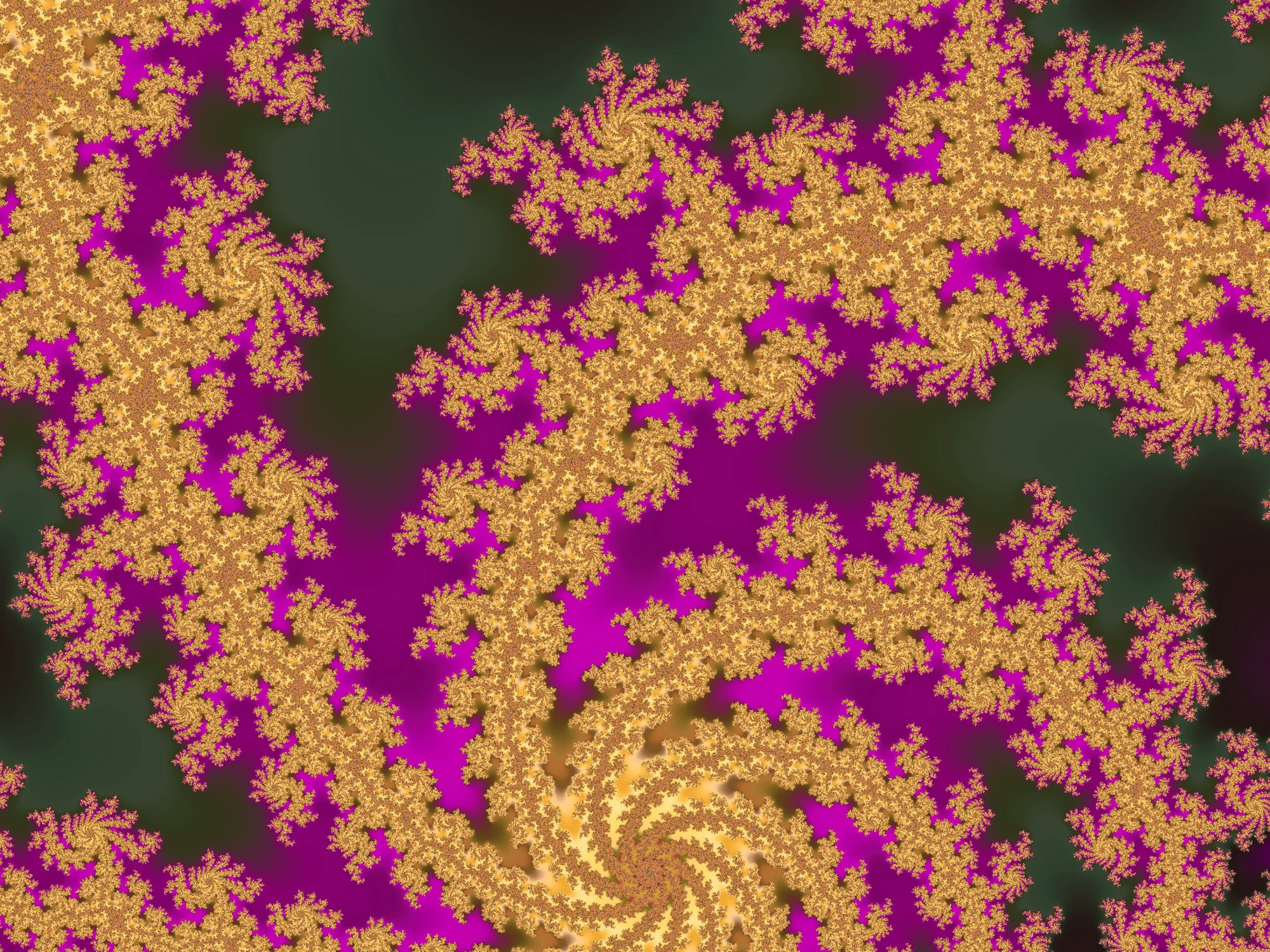
The Mystery of Infinite Novelty
Out of all the wonders in mathematics, few are as endlessly surprising as the Mandelbrot set. You can zoom into it for minutes, hours — or the rest of your life — and you will never see the same pattern twice. Shapes may feel familiar, echoes may appear, and motifs return in distorted forms…but an exact repeat? It simply never happens.
So why is that?
Let’s dig into one of the most beautiful ideas in modern mathematics: infinite novelty emerging from a single equation.
A Simple Rule With an Impossible Horizon
At the heart of the Mandelbrot set is an update rule so short you can write it on a napkin:
Start with z = 0 and repeatedly compute:
z → z² + c
Where c is a point on the complex plane.
That’s it.
Yet this tiny recurrence generates an object with an infinite amount of structure. Each tiny region of the set’s boundary is different from every other one, because the dynamics of the equation are wildly sensitive to the exact value of c.
Self-Similarity, But Not Repetition
A common misconception is that the Mandelbrot set repeats itself. It doesn’t.
It shows self-similarity, but it’s the “approximate” kind, not the copy-paste kind. Mini-Mandelbrots appear everywhere, but the worlds around them are always different — rotated, warped, spiraled, stretched, twisted, or embedded in completely unique surroundings.
Think of it like genetics:
- Shared DNA
- But infinite variations
- No two individuals identical
The Mandelbrot boundary is the same way: familiar themes woven into infinite diversity.
A Boundary Made of Chaos
The black interior of the Mandelbrot set is calm. Stable. Predictable.
But the boundary — the razor-thin edge where points flip from stable to chaotic — is mathematically one of the wildest objects known. It’s so intricate that:
- Every point on the boundary encodes a unique dynamical history
- The structure has infinite detail, no matter how far you zoom
- There is no smallest feature — magnify forever, and more appears
This “edge of chaos” is what keeps novelty alive at all scales. You never run out of new things to see because the mathematics never runs out of detail to reveal.
Infinite Complexity From Binary Behavior
What makes the Mandelbrot set so fascinating is that every point is effectively answering a yes/no question:
Does this point escape to infinity, or not?
Just that. Yet when you plot the answers on a plane, you get something richer and more intricate than a coastline, cloud, or galaxy.
Zoom somewhere new, and the pattern around you is the result of:
- Slightly different dynamics
- Different escape timings
- Different pathways through the iterative process
This is why even deeply familiar regions explode into brand-new architecture the moment you move a tiny bit.
It’s Not Just Big… It’s Unbounded
The complexity isn’t just large — it’s infinite.
Zoom in a million times (10⁶) and you’re still barely scratching the surface. Zoom deeper — 10⁹, 10¹², or even a googol (10¹⁰⁰) — and the fractal keeps generating new landscapes, new filigrees, new spirals, new structures that have never existed before in any universe.
It never ends because the equation never stabilizes into repetition.
A Universe That Always Has More to Show
The Mandelbrot set is often called the most complex object in mathematics for a reason. It sits at the crossroads of order and chaos, stability and instability — a mathematical frontier where novelty is limitless.
And that’s why people keep exploring it.
That’s why artists turn to it.
That’s why mathematicians can’t let it go.
Because every time you look closer, the fractal gives you something new.
Always.