

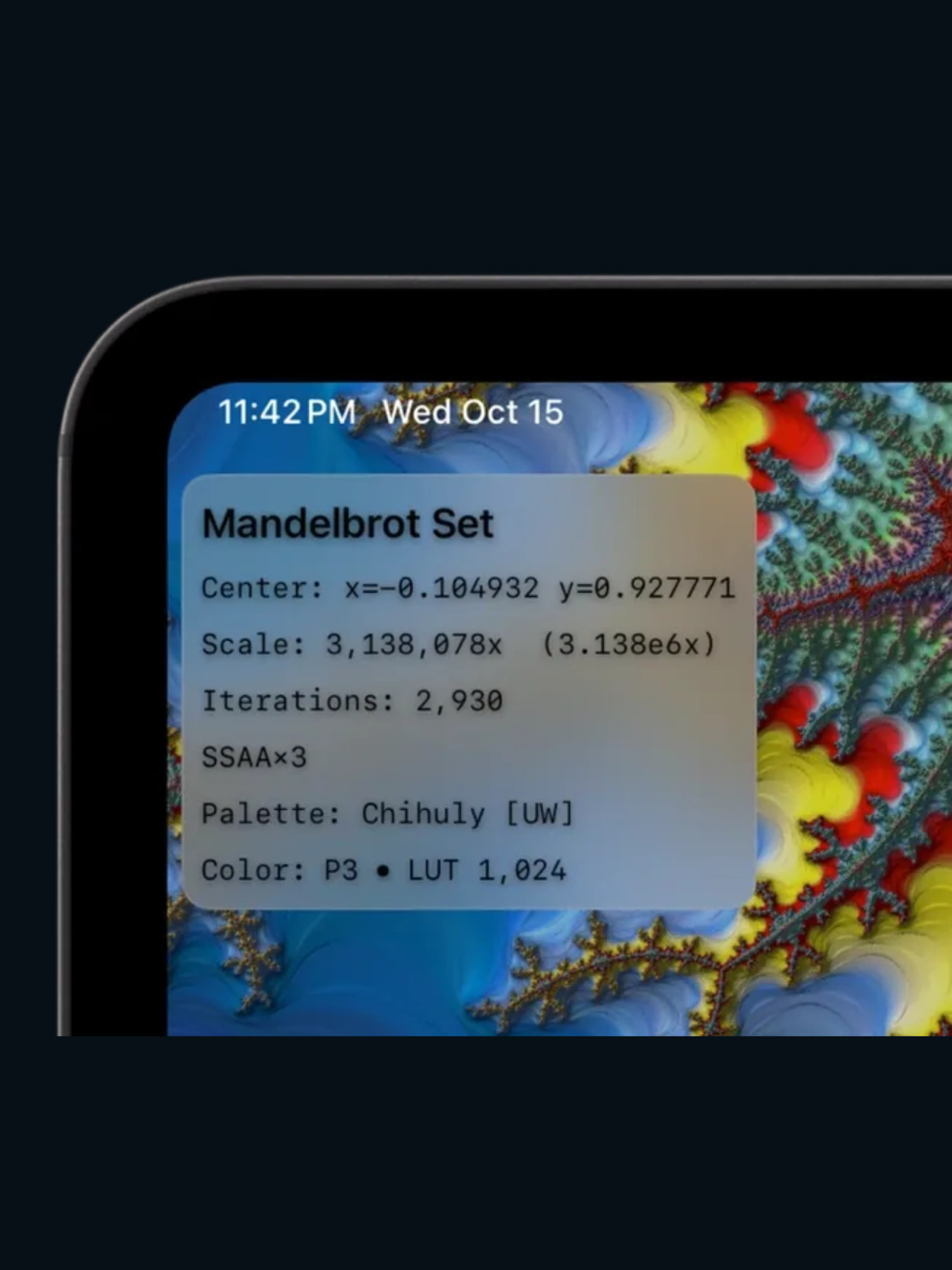
One of the most common questions users ask is: “Why do I need more iterations when I zoom in?”
After all, the formula that defines the Mandelbrot set — zₙ₊₁ = zₙ² + c — is simple and doesn’t change with zoom level. So why does the image suddenly lose detail or turn solid at deeper magnifications unless we raise the iteration limit?
The Escape-Time Algorithm: A Quick Refresher
Every pixel in the image corresponds to a complex number c.
We start with z₀ = 0 and repeatedly apply the iteration: zₙ₊₁ = zₙ² + c
If |zₙ| ever exceeds 2, the sequence “escapes,” and we color the pixel based on how many steps it took to escape.
That escape count — n — is what gives the smooth gradients and structure to the image. If we stop too soon (low max iterations), we lose fine boundary detail; if we go long enough, the image shows the intricate tendrils and spirals that define the fractal.
Why Zoom Changes the Game
When you zoom in by a factor of M, you’re effectively scaling the coordinate plane by 1/M.
Tiny differences in c—on the order of 1/M—can cause massive differences in escape time.
Mathematically, the local dynamics near the boundary of the Mandelbrot set become more stiff as you zoom in: points that once escaped in, say, 50 iterations may now take thousands. The orbit wanders closer and closer to the boundary before escaping, and that boundary gets exponentially more complex with magnification.
In practice, this means we must increase maxIterations roughly in proportion to the zoom level to maintain visible detail.
Empirical Rule of Thumb
While there’s no single universal formula, a useful approximation for how maximum iterations scale with zoom is:
maxIterations ≈ A * log₁₀(M) + B
Here’s what each term means:
- M is the magnification factor — how many times closer you are compared to the original view (e.g., a zoom of 1e6 means one million times magnified).
- A is a proportional constant that determines how aggressively iterations increase with magnification. Higher A values yield sharper fine detail but require more computation.
- B is a baseline offset — the minimum number of iterations needed at lower magnifications to capture the fractal’s boundary cleanly.
For extremely deep zooms, this relationship becomes nonlinear. In those cases, a stronger approximation is sometimes used:
or, for very deep zooms: maxIterations ∝ √M
In Mandelbrot Metal, this relationship is handled automatically when Auto Iteration is enabled. The app analyzes the current magnification and adaptively raises the iteration cap to maintain detail and color smoothness—without overburdening performance.
Visual Example
Putting It All Together
Each zoom level magnifies both spatial detail and computational complexity.
To preserve the same apparent level of detail, we must extend the iteration depth proportionally to how long orbits near the boundary take to escape.
This is what gives the Mandelbrot set its infinite richness—and why your device works harder the deeper you explore.
In Mandelbrot Metal
- Auto Iteration dynamically adjusts the iteration cap as you zoom.
- Iteration Cap lets advanced users fix it manually (5k, 15k, 50k, etc.).
- Deep Rendering Mode activates at extreme magnifications, using higher-precision CPU math for accuracy.
This balance ensures that as magnification increases, so does the level of mathematical fidelity.
In essence, each pixel becomes its own micro-universe of iteration depth.