

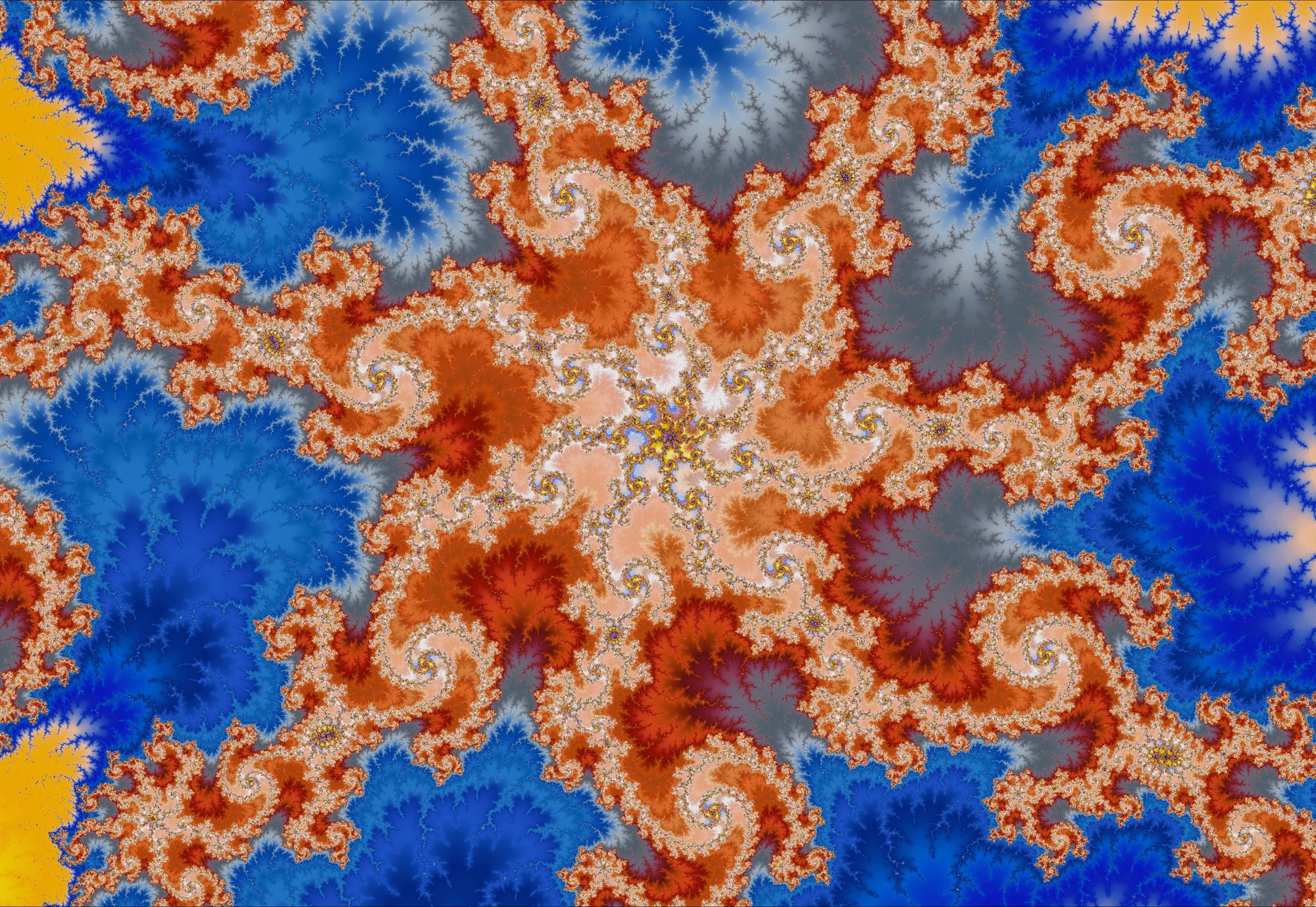
Out of the simplest rules, the most intricate worlds can emerge.
That idea has fascinated mathematicians, artists, and philosophers for centuries — and it sits at the heart of the Mandelbrot set. The entire fractal universe we explore in Mandelbrot Metal comes from a deceptively small equation:
zₙ₊₁ = zₙ² + c
That’s it — a single line of math. Yet, through endless repetition, it generates shapes of unimaginable complexity. Each swirl, filament, and spiral is born from pure logic, yet feels almost organic — as if the equation were alive.
This balance between simplicity and complexity echoes a theme Douglas Hofstadter explored in his Pulitzer Prize–winning Gödel, Escher, Bach: An Eternal Golden Braid. Hofstadter described how self-reference and recursion can give rise to meaning, structure, and creativity — the same forces at play when a fractal folds infinitely into itself. What Escher drew, Bach composed, and Gödel proved, the Mandelbrot set shows us visually: how structure can emerge from chaos, and how beauty can emerge from math.
The Equation That Paints the Infinite
The Mandelbrot set begins with a simple rule: take a complex number c, start with z = 0, and repeatedly square and add c.
If that process stays bounded forever, c belongs to the Mandelbrot set. If it eventually escapes to infinity, it doesn’t. Color each point based on how fast it escapes, and a hidden world appears — one filled with spirals, tendrils, valleys, and galaxies of shape.
In Mandelbrot Metal, that process unfolds in real time, powered by Apple’s Metal GPU framework. Every pixel becomes a miniature test of chaos versus stability, iterated thousands of times per second. The result isn’t just math — it’s living geometry, rendered with cinematic depth and color fidelity.
Patterns Within Patterns — The Essence of Recursion
Recursion is the beating heart of both fractals and creativity. In Gödel, Escher, Bach, Hofstadter described how recursive structures — from Bach’s fugues to Escher’s infinite staircases — create “strange loops”: systems that fold back upon themselves, generating endless complexity from self-reference.
The Mandelbrot set is recursion made visible. Zoom into any region, and you’ll find echoes of the whole — smaller “baby Mandelbrots” repeating endlessly, yet never exactly the same. This self-similarity without duplication is what makes fractals so mesmerizing: they’re predictable in form but unpredictable in detail.
Each zoom feels like a musical modulation, a shift in key or tempo. At one scale, smooth valleys flow like a cello line; zoom deeper, and turbulent filigrees twist like counterpoint. The patterns you reveal depend entirely on where you look — just as a melody’s meaning depends on how you listen.
The Edge Between Chaos and Order
Mathematically, the boundary of the Mandelbrot set is one of the most complex structures ever discovered. It’s where chaos and order meet — infinitely detailed, yet infinitely stable. This edge region, known as the fractal frontier, is where the beauty truly lives.
Points just inside the boundary remain forever trapped in stability; points just outside diverge into chaos. And yet, when visualized, this razor-thin division produces endlessly evolving forms — spirals that bloom into feathers, valleys that morph into seahorses, galaxies, and dendrites.
In a way, that boundary mirrors life itself: complex, dynamic, and balanced between stability and change. It’s the mathematical embodiment of what Hofstadter called “the eternal braid” — the intertwined dance of logic, art, and consciousness.
Seeing the Music of Math
Fractals are often called visual music, and for good reason. Like a symphony, they’re composed of repetition, variation, and transformation. Bach built his fugues on recursive motifs — themes that return transformed but recognizable. The Mandelbrot set does the same with shapes.
When you explore a fractal, you’re not just seeing color and form; you’re witnessing a kind of rhythm — a structure unfolding across scales, governed by pure logic yet capable of infinite variation.
In Mandelbrot Metal, features like Ultra-Wide 768-step color palettes, 3D Look lighting, and deep precision rendering make that rhythm visible. Each color progression becomes a phrase; each lighting contour a harmonic shift. It’s not an exaggeration to say you can listen with your eyes.
The Infinite Mirror
Zoom deep enough into the Mandelbrot set, and you start to feel something uncanny: a sense that each pattern contains echoes of itself, stretching infinitely in both directions. It’s a visual metaphor for consciousness — and one Hofstadter drew upon to explore how meaning and self-awareness might emerge from recursive systems.
In that sense, every deep dive into a fractal becomes a meditation. You’re exploring not just the boundaries of math, but the structure of thought itself — a mirror reflecting both the universe’s logic and your own curiosity.
That’s what makes the Mandelbrot set so endlessly compelling: it blurs the line between discovery and creation. Each zoom is a journey into order born from chaos, simplicity blossoming into beauty — an infinite conversation between math, art, and the human mind.
Author’s Note
Written by Michael Stebel, creator of Mandelbrot Metal — a real-time fractal explorer for iPhone and iPad that brings mathematical beauty to life through GPU precision and limitless color.
Explore community-shared bookmarks.
Learn more about the math and algorithms used in the app.