
Why We Keep Seeing the Mandelbrot Set in the Real World
People often ask why fractals feel natural.
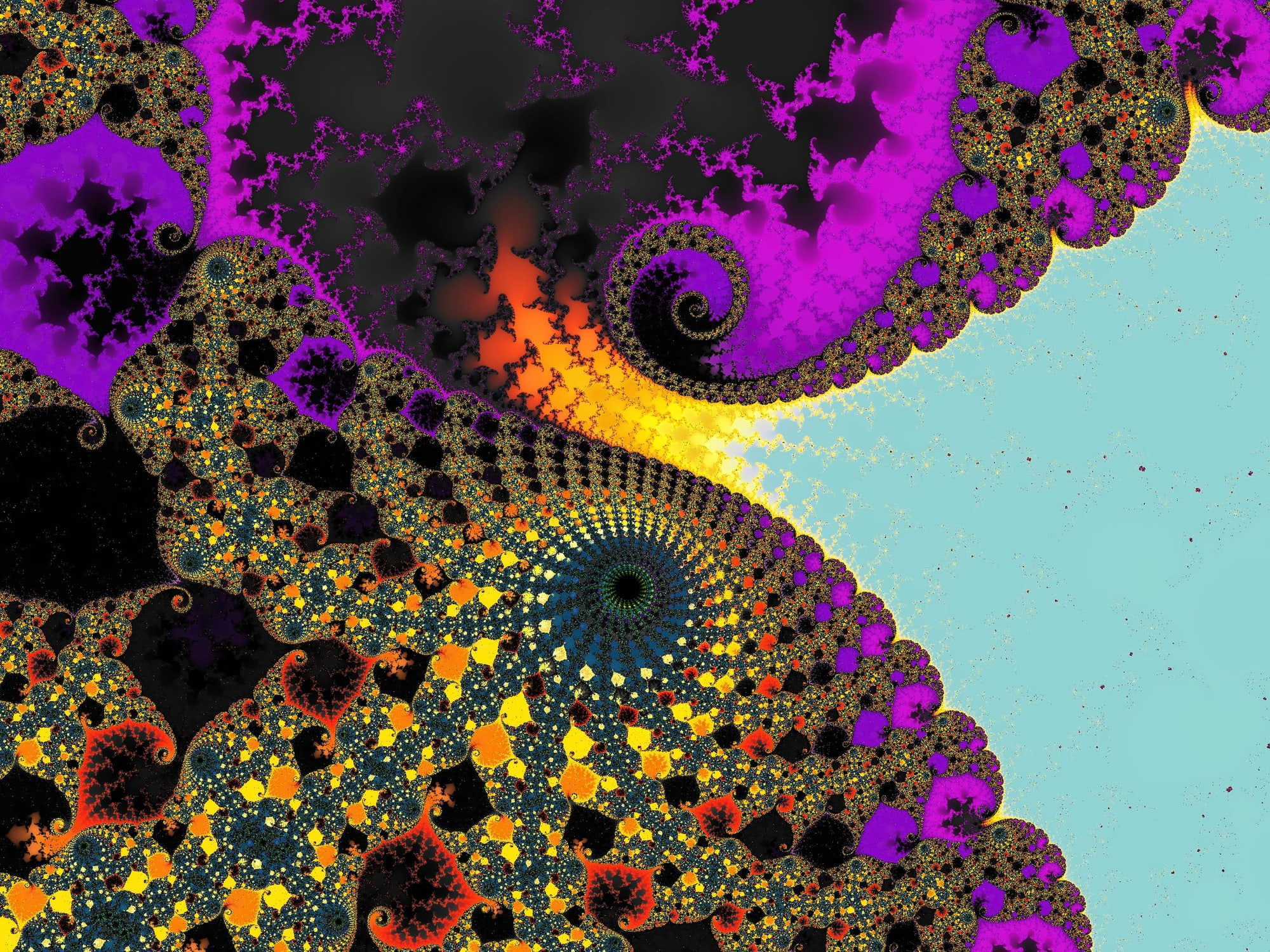
Why a deep zoom into the Mandelbrot set can look like coral, smoke, mountain ridges, or plant growth. Why does something generated by a simple mathematical rule seem to echo patterns we recognize from the real world?
The short answer is:
It’s not a coincidence — and it’s not imitation.
It’s structure.
Nature Doesn’t Draw Straight Lines
Very little in nature is smooth or Euclidean. Coastlines don’t have a single length. Trees don’t branch at perfect angles. Clouds don’t have crisp edges.
Instead, nature favors:
- repetition with variation
- growth through branching
- structure that looks similar at different scales
These are precisely the properties fractals describe.
When Benoît Mandelbrot famously asked “How long is the coast of Britain?”, the unsettling answer was: it depends on how closely you look. Zoom in, and new detail keeps appearing. Zoom out, and the structure remains recognizable.
That idea — scale invariance — sits at the heart of fractal geometry.
See my post "The Coastline Paradox."
The Mandelbrot Set Isn’t Copying Nature
It’s tempting to say the Mandelbrot set “looks like” nature, but that framing is backwards.
The Mandelbrot set isn’t mimicking trees, shells, or clouds.
It’s revealing the same underlying mathematics that nature exploits.
Simple iterative rules applied repeatedly tend to produce:
- branching
- filigree
- recursive detail
- edge complexity
Nature arrives at these patterns through physics, chemistry, and biology.
The Mandelbrot set arises from pure iteration.
Different paths. Same destination.
Why Our Brains Instantly Recognize These Patterns
There’s a perceptual reason fractals feel familiar.
Human vision evolved to interpret natural environments — forests, terrain, weather, and organic forms. Our brains are exceptionally good at recognizing:
- self-similar structure
- irregular repetition
- patterns without strict symmetry
When we see a fractal image, especially at deep zooms, it triggers the same visual heuristics we use to interpret the real world. The image feels meaningful, even when it’s entirely abstract.
That’s why fractals often feel:
- organic rather than mechanical
- alive rather than static
- discovered rather than designed
Zooming Deeper Reveals, Not Randomness — But Order
One of the most surprising things about fractals is that deeper zooms don’t dissolve into noise.
They become more structured.
New shapes emerge. Motifs repeat. Regions develop distinct “personalities.” Some areas feel architectural. Others fluid. Others are almost biological.
This isn’t chaos.
It’s deterministic complexity.
Every detail comes from the same equation — applied again and again — with no randomness involved.
Fractals as a Bridge Between Math and the Natural World
Fractals occupy a strange middle ground:
- mathematically exact
- visually expressive
- emotionally resonant
They remind us that mathematics isn’t just a tool for measurement. It’s also a language that nature seems fluent in.
When you explore a fractal deeply enough, you’re not just looking at math.
You’re looking at structure itself — the kind that appears wherever simple rules are allowed to repeat without constraint.
One Equation. Endless Worlds.
That’s why fractals continue to surprise.
Not because they invent new shapes —
But because they keep revealing patterns we already know, embedded in places we didn’t expect to find them.
Learn more about fractals.
Fractal of the Week:
"Stranger Things Fractal"
In honor of the Stranger Things finale, I've created this creepy fractal image in Mandelbrot Metal using the Redrum [UW] palette.
👉 Get the Mandelbrot Metal bookmark to import this exact image and explore it on the Community Portal.