
When people think of π, they usually think of circles.
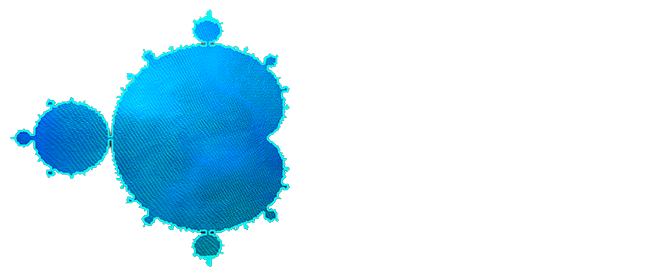
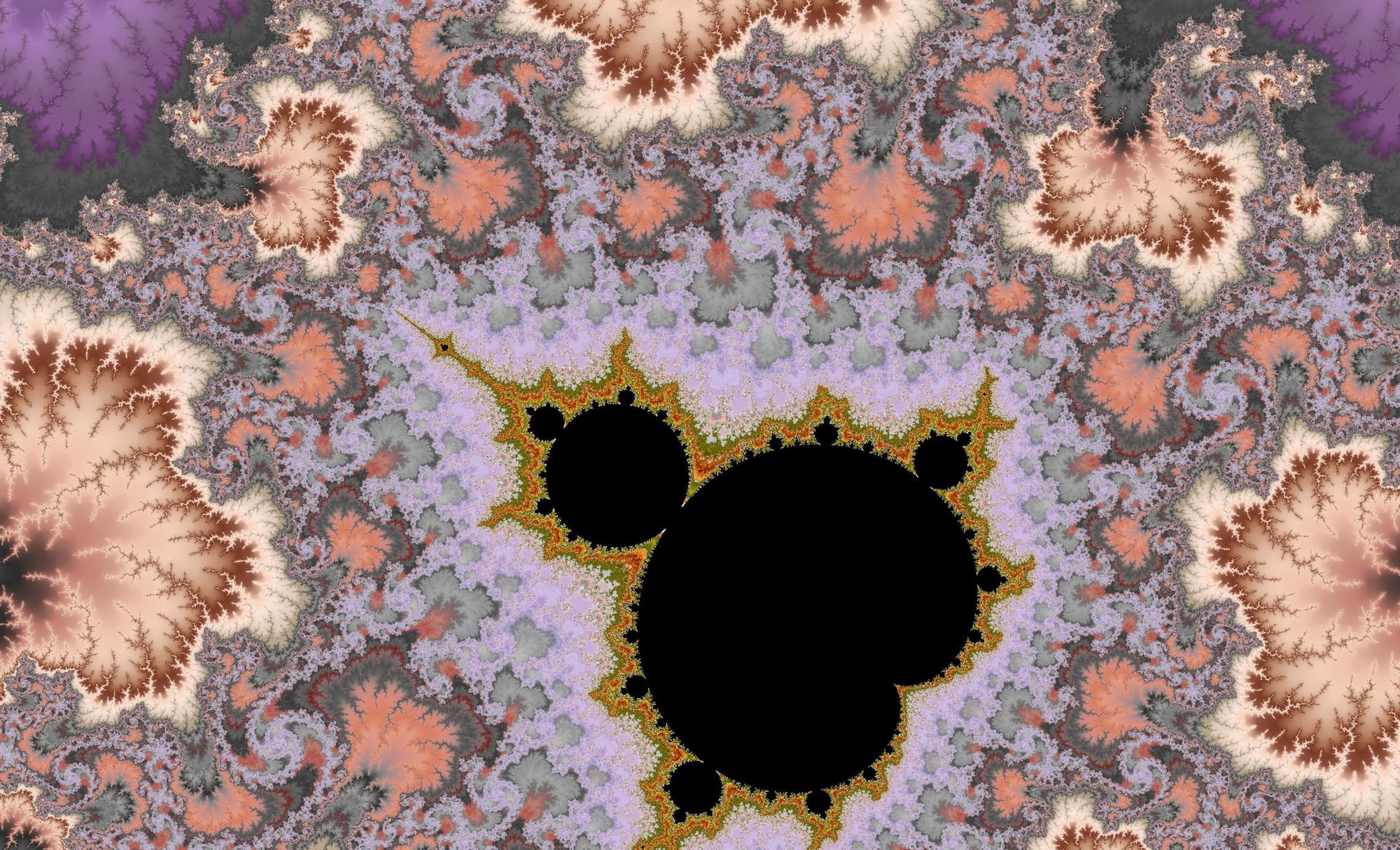
When people think of fractals, they think of infinite detail, self-similarity, and shapes like the Mandelbrot set.
At first glance, these seem like very different worlds. One belongs to classical geometry; the other feels almost alien. But there is a connection between them. In fact, π appears in fractal mathematics in several important ways — just not always in the obvious, “circle formula” sense.
The short answer is this:
π is not the defining constant of fractals, but it appears naturally whenever fractal mathematics touches angles, rotation, complex numbers, waves, or geometry itself.
That makes the relationship real, even if it is not always central.
π belongs to classical geometry
π is one of the most famous constants in mathematics because it emerges from the geometry of circles:
- circumference = 2𝛑r
- area = 𝛑r²
It also appears throughout trigonometry, oscillation, and wave behavior. Once angles are measured in radians, π is everywhere.
That is why π shows up not only in circles, but in:
- rotation
- periodic motion
- Fourier analysis
- complex exponentials
- signal processing
- physics
So π is bigger than circles. It is really a constant of cyclic and angular structure.
Fractals belong to recursive geometry
Fractals come from a different mathematical instinct.
Rather than describing smooth, idealized shapes, fractals describe forms generated by iteration, self-similarity, and scale repetition. A fractal often reveals more structure the more closely you examine it. Some fractals repeat in exact ways; others, like the Mandelbrot set, produce endless variation that still follows a deep internal order.
Fractals often challenge classical intuition:
- a curve can be infinitely long while enclosing a finite area
- a boundary can be infinitely intricate
- a shape can behave as though it lives between dimensions
That is why fractals feel so different from the circles and triangles of traditional geometry.
So where do π and fractals meet?
They meet wherever recursive geometry intersects with angle, rotation, periodicity, or measurement.
Here are the main connections.
1. π appears naturally in the complex plane
Many of the most famous fractals — including Julia sets and the Mandelbrot set — are built from complex numbers.
A complex number can be written in rectangular form:
z = x + iy
or in polar form:
That angle 𝜃 is measured in radians, which immediately brings π into the picture.
So even though the Mandelbrot set is usually introduced through the iteration z → z² + c, the deeper mathematics behind how complex numbers rotate and scale is full of π. Every time angle matters, π is nearby.
2. Fractals often involve rotation and symmetry
Many fractal systems generate rotational structure:
- spirals
- branching forms
- radial symmetries
- angular repetition
- bulbs and lobes in the Mandelbrot set
Those patterns are often easiest to understand through angular relationships, and angular relationships naturally bring in π.
In other words, π enters fractal mathematics not because fractals are “about circles,” but because many fractals live in spaces where rotation matters.
3. Fractals push beyond the geometry where π first became famous
One of the most interesting relationships between π and fractals is almost philosophical.
π is central to smooth Euclidean geometry. Fractals, by contrast, often describe rough, irregular, infinitely detailed boundaries. In that sense, fractals expose the limits of the tidy geometry in which π first became famous.
A circle has a perfectly smooth perimeter.
A fractal boundary may have no smoothness at all.
A circle’s perimeter and area are captured cleanly by formulas involving π.
A fractal may have finite area and an infinitely complicated boundary.
So π and fractals are connected partly through contrast: fractals show what happens when geometry stops being smooth.
4. π also appears in dimension and measure
Classical geometry gives us familiar formulas like:
- circle area: 𝛑r²
- sphere volume: 4/3 𝛑r³
Fractals introduce the idea that dimension itself does not have to be an integer. A fractal curve may have a dimension greater than 1 but less than 2. A fractal surface may sit somewhere between 2 and 3.
In more advanced mathematics, π appears in formulas that generalize area, volume, and measure across dimensions. So while π is not unique to fractals, it still appears in the broader mathematical machinery used to describe geometric scaling and dimension.
A Mandelbrot-specific view: where π appears, and where it does not
For people working directly with Mandelbrot rendering, this is where the question becomes especially interesting.
The Mandelbrot set itself is defined by a very simple iterative rule:
where Z₀ = 0
At the most basic level, π does not appear in that definition.
That is important. The Mandelbrot set does not depend on π the way a circle does. You do not need π to define escape-time iteration, calculate the next orbit value, or determine whether a point remains bounded.
So in core escape testing, π is not fundamental.
But π absolutely appears around the edges of Mandelbrot mathematics and rendering.
1. π appears through angle in complex dynamics
Even though the iteration formula is algebraic, the values being iterated are complex numbers. Complex multiplication has a rotational interpretation.
When a complex number is squared:
- its magnitude is squared
- its angle is doubled
If a number is written as re^{i\theta}, then squaring gives:
That angle doubling is inherently angular, and angular behavior is naturally expressed using π.
So while the Mandelbrot formula itself does not mention π, the behavior of the iterates can be understood geometrically in ways that do.
2. π appears in external angles and parameter structure
One of the deeper ways mathematicians study the Mandelbrot set is through external rays and external angles. These describe how points in the complex plane correspond to angular directions approaching the set from infinity.
Those angles are commonly expressed as fractions of a full turn, which means π or 2\pi is always present in the background.
This is where the connection becomes much more than decorative. In serious complex dynamics, angular structure is central, and π comes with it.
3. π can appear in coloring formulas
In rendering, π often shows up not in the set itself, but in how the image is displayed.
For example, coloring algorithms may use:
- sine and cosine waves
- cyclic palette maps
- smooth hue rotation
- periodic modulation
- angle-based shading
All of those can involve π.
A palette function might use something like: sin(2𝛑t)
or phase-shifted cosine curves to generate smooth color transitions. In that context, π becomes part of the visual language of fractal art, even though it is not part of the escape condition.
4. π can appear in distance estimation and normal-based shading
More advanced fractal rendering techniques sometimes use geometry derived from the complex field around the set:
- distance estimation
- gradient direction
- normal approximation
- lighting models
- angular mapping
Once you start measuring direction or applying wave-based shading, π often reappears.
So from a rendering perspective, π is often not in the core membership test, but it can become very relevant in how the fractal is analyzed, shaded, and colored.
5. π is not required for escape-time rendering
This point is worth stating clearly.
If you are doing basic Mandelbrot escape-time rendering, the essential ingredients are:
- complex arithmetic
- iteration
- bailout testing
- iteration counting
That can all be done without using π at all.
So the relationship between π and the Mandelbrot set is not like the relationship between π and a circle. It is not foundational in the same way.
Instead, π enters when you move into:
- angular interpretation
- complex analysis
- external ray theory
- continuous coloring
- trigonometric palette design
- geometric post-processing
That is a more subtle connection, but a very real one.
Why this matters artistically
There is also a creative way to think about this.
π is associated with smooth cyclic order.
Fractals are associated with recursive complexity.
When fractal art uses rotational symmetry, color waves, spirals, or rhythmic palette transitions, those two worlds begin to overlap. The result is one reason fractals can feel both mathematically precise and visually alive.
That duality is part of what makes them so compelling.
A fractal image may be born from a simple iterative rule, yet the moment you introduce angular analysis, periodic coloring, or circular symmetry, π starts quietly shaping the result.
Final thought
So, is there a connection between π and fractals?
Yes — but usually not in the simplistic sense.
π does not define fractals the way it defines circle geometry. But it appears naturally wherever fractals intersect with:
- angle
- rotation
- complex numbers
- periodicity
- dimension
- geometric measurement
And in Mandelbrot-specific work, that means:
- π is not part of the core escape-time definition
- π does appear in angular interpretation, deeper theory, and many rendering techniques
That makes the connection both mathematically honest and creatively rich.
In a way, π governs the smooth language of cycles and rotation, while fractals explore the rough language of recursion and infinite detail. Where those two languages meet, some of the most beautiful mathematics begins.